

Last Updated: November 5, 2026
Quick Summary
Embossed initials do not wear off in the way most people fear, because the letters are pressed into the material itself rather than applied as ink or foil. What changes over time is how crisp the impression looks, not whether your letters survive.
- Debossed initials generally hold their definition slightly longer than embossed ones because the letters sit recessed.
- A well-set impression on full-grain leather can remain legible for a long time.
- Edges of the letters may round slightly within the first year of daily use.
- Wipe leather weekly with a dry microfibre cloth to lift abrasive dust.
- Never scrub directly across embossed letters with a stiff brush or abrasive pad.
Table of Contents
- How Embossing and Debossing Create Lasting Initials
- How Long Do Embossed Initials Last on Leather?
- Embossed vs Debossed Leather: Which Holds Up Better?
- What Order Do Initials Go in a Monogram?
- Keeping Embossed Initials Crisp: Care and Prevention
- Choosing a Personalised Case That Keeps Its Finish
- Frequently Asked Questions
How Embossing and Debossing Create Lasting Initials
Do embossed initials wear off? In short, no, not in the way most people fear. On quality leather and vegan leather goods, the initials are pressed into the material itself, so there is no layer of ink or foil to peel away. What changes over time is how crisp the impression looks, not whether your letters survive.
Embossing is the process of pressing a design into leather so it sits raised above the surface. A heated metal die, cut with your chosen letters, is pressed hard into the material. The heat and pressure compress the fibres beneath the die. Those fibres stay flattened, and the surrounding leather stays raised. The result is a permanent change to the structure of the material, not a coating sitting on top of it.
That distinction matters. A printed or foiled initial sits on the surface and can flake. A pressed initial is part of the surface.
Heat, Pressure and Leather Fibres
The die does two things at once. Heat softens the material slightly, and pressure reshapes it. Leather fibres are dense and springy, so once they are compressed under a die, they largely stay that way.
Three factors decide how sharp the result looks:
- Temperature: too cool and the impression is shallow and soft
- Pressure: too light and the letters blur at the edges
- Dwell time: too brief and the impression fades faster with use
A well-made press leaves a clean, defined edge. A rushed one leaves a shallow mark that loses definition sooner. This is why the quality of the personalisation service matters more than the wording on the packaging.
How Long Do Embossed Initials Last on Leather?
There is no single answer, because the leather itself is the biggest variable. A pressed impression is only as durable as the surface it sits in, and different leathers and finishes respond to heat, pressure and wear in very different ways. A well-set impression on full-grain leather can remain legible for a long time, while corrected-grain, coated or synthetic materials may lose definition sooner.
Here is how the main material types tend to behave:
- Full-grain leather: The dense, open fibres take a deep, clean impression and hold it well. The surface polishes with handling rather than flaking, so the initials soften gradually but rarely disappear.
- Top-grain and corrected-grain leather: The surface has been sanded or corrected, so the fibres are tighter and less absorbent. Impressions can be crisp initially but may shallow faster if the finish is thin.
- Coated or finished leather: A polymer or pigment coating sits over the grain. Heat and pressure can press through it, but the coating itself may crack or lift at the edges of the letters over time, especially on flex points.
- Vegan leather and synthetics: These vary enormously. A good quality PU or microfibre-based material can hold a pressed impression well, but cheaper synthetics may rebound or develop a shiny, flattened patch where the die pressed.
Use frequency and contact points matter just as much. An embossed monogram on a card holder that lives in a pocket will see more abrasion than one on a bag that hangs from a shoulder. High-contact areas, the corner of a phone case, the flap of a wallet, the handle of a briefcase, will show softening first. A common pattern is for the edges of the letters to round slightly within the first year of daily use, while the overall impression remains readable for years.
A realistic expectation is that the initials will not stay factory-sharp indefinitely, but they will not peel or vanish either. What changes is crispness and contrast, not the presence of the letters. If you need the impression to stay as defined as possible, choose a debossed or blind impression on a dense leather, and keep the item away from repeated friction.
Embossed vs Debossed Leather: Which Holds Up Better?
Debossed initials generally hold their definition slightly longer than embossed ones, because the letters sit recessed and are shielded from direct abrasion. Embossed initials sit proud of the surface and take more contact from pockets, bags and desks.
Here is how the two compare in practice:
Feature |
Embossed |
Debossed |
|---|---|---|
Letter position |
Raised above surface |
Pressed below surface |
Abrasion exposure |
Higher |
Lower |
Initial crispness |
Strong, softens with wear |
Stays defined longer |
Visual effect |
Bold, sculpted |
Subtle, understated |
Best for |
Statement personalisation |
Quiet, tonal personalisation |
Neither is "better" in absolute terms. Choose embossed if you want the initials to be a visible feature. Choose debossed if you prefer a quieter look that ages more slowly.
If you are drawn to the debossed look, our personalised pebble grain iPhone cases show how a textured finish pairs with pressed personalisation.
What Order Do Initials Go in a Monogram?
The traditional three-letter monogram places the surname initial in the centre, larger than the others, with the first name on the left and middle name on the right. For a two-letter monogram, the standard is first name then surname.
Personalised Pebble Grain iPhone Case →
So for someone named Sarah Jane Miller, the classic monogram reads S M J, with the M largest.
A few practical rules worth knowing:
- Two letters: first name initial, then surname initial
- Three letters: first, surname in the middle, middle name last
- Married couples: shared surname in the centre, first initials either side
- Single initial: the surname is the traditional choice
If you are ordering a gift and are unsure, a single surname initial is the safest option. It is harder to get wrong and reads as considered rather than careless.
Keeping Embossed Initials Crisp: Care and Prevention
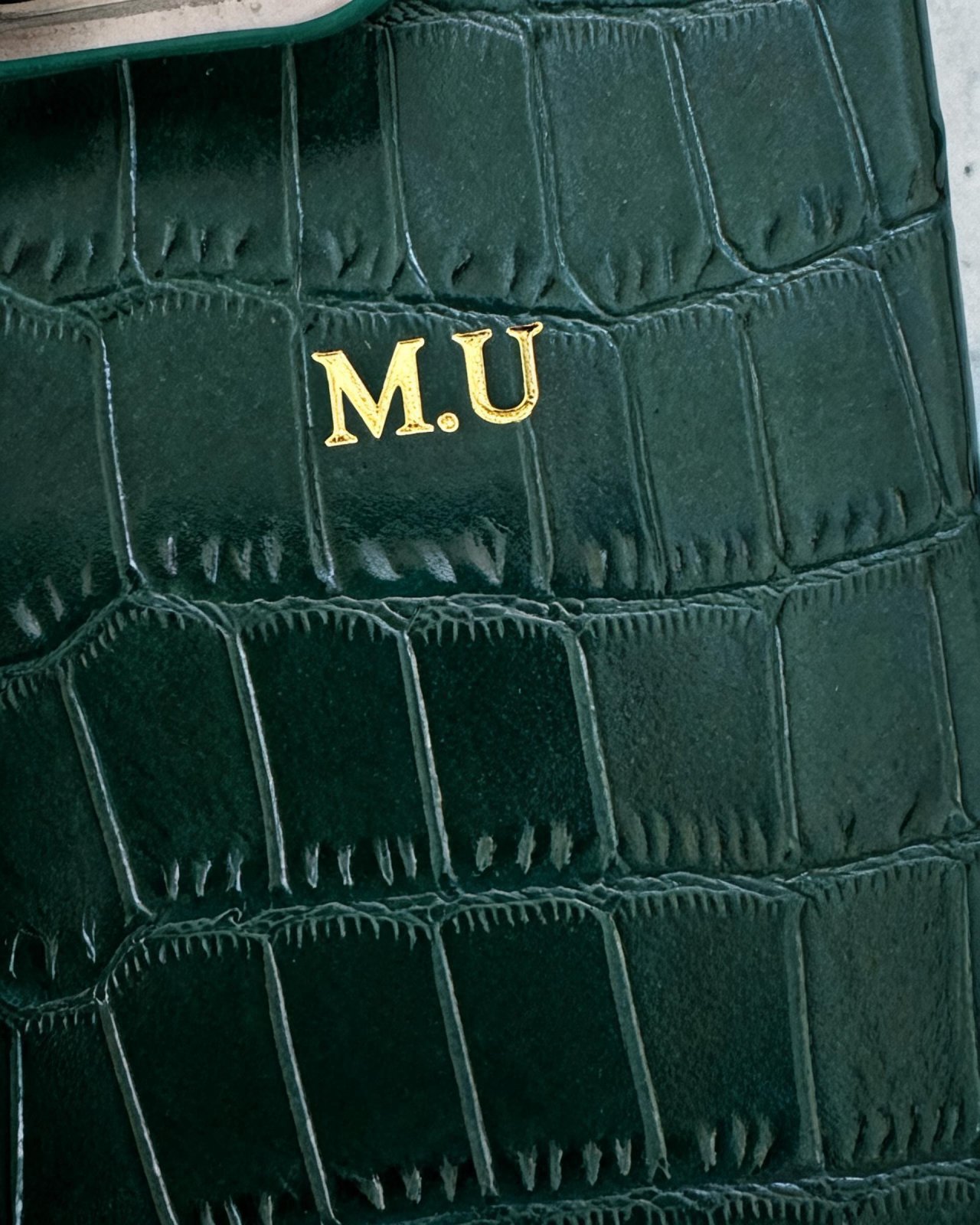
The single biggest threat to embossed initials is not time. It is abrasion, followed by heat and moisture. Keys in the same pocket, a rough bag lining, or a gritty desk surface will wear the raised area faster than normal handling ever would. But the right care routine depends on the material, so treat these as principles rather than a fixed checklist.
For full-grain and top-grain leather:
- Wipe with a dry microfibre cloth weekly to lift dust before it becomes abrasive.
- Condition lightly two to four times a year with a pH-balanced leather cream, working it in with a fingertip and buffing after ten minutes. Avoid over-conditioning, which can soften the fibres and reduce impression depth.
- Keep the item in a dust bag when stored, and avoid cramming it against hard objects.
- Let the leather dry naturally if it gets wet; never use a hairdryer or radiator, as heat can relax the pressed fibres.
For coated, finished or vegan leather:
- Use a damp cloth with a little mild soap rather than solvent cleaners, which can dull or lift the coating around the letters.
- Avoid alcohol-based wipes and harsh detergents entirely; they attack the finish that holds the impression.
- Store away from direct sunlight, which can make some coatings brittle over time.
Watch out: never scrub directly across the embossed letters with a stiff brush or abrasive pad. You will flatten the impression and dull the definition in one go, and on coated leather you may also scuff the finish.
On coated or synthetic materials, re-pressing is riskier because the finish may crack or shine. Ask before you attempt anything yourself; home remedies such as steam or heat guns tend to make the surface worse. For valuable pieces, a conservator is the safer route than a general cobbler.
EXTERNAL_LINK: The Leather Conservation Centre on caring for leather objects | leatherconservation.org
Choosing a Personalised Case That Keeps Its Finish
The best way to protect embossed initials is to start with a piece made properly. At Insignia Cases, our personalised cases feature custom embossed initials on premium vegan leather with designer-inspired textures, including pebble grain and croc finishes.
A few things to check before you order from any provider:
- How the initials are applied: pressed, printed, or foiled
- The material: textured finishes hide minor wear better than smooth ones
- The finish options: gold or silver lettering sits differently on each colourway
- The return policy: personalised items are usually non-returnable, so check first
Our personalised iPhone cases come in a range of classic colours with gold or silver lettering, and our returns policy explains how custom orders work before you commit.
Frequently Asked Questions
Do embossed initials wear off?
The impression itself rarely disappears, because heat and pressure compress the leather fibres rather than adding a separate layer. What does change is how visible the initials look: surface oils, abrasion and dirt can flatten the recessed or raised design over time. Cleaning and conditioning the leather helps keep the definition sharp.
How long do embossed initials last on leather?
Lifespan depends on the leather type, how often the item is handled, and whether it is exposed to friction inside a bag or pocket. On a phone case that is used daily, expect the impression to stay readable but the sharpest edges to soften gradually. Foil-stamped initials can flake sooner than a blind embossed impression.
Do embossed or debossed initials last longer?
Both last well when done correctly, but they wear differently. Debossed initials sit below the surface, so they are shielded from direct rubbing and tend to hold their definition longer on items that see heavy friction. Embossed initials are raised and catch more contact, so the edges can smooth out sooner.
What order do initials go in a monogram?
For a three-letter monogram, the traditional order is first initial, then the larger surname initial in the centre, then the middle initial, so the surname sits prominently in the middle. For a two-letter monogram, the first name comes first, then the surname.
Embossed initials do not wear off, but they do deserve a little care to stay sharp. If you want personalisation that is pressed into the material and built to last, Insignia Cases offers custom embossed initials on premium vegan leather, with designer-inspired textures and fast worldwide shipping. Browse the collection and make your case unmistakably yours.
